Progress Report: THE Embodied Mathematical Imagination and Cognition Working Group Informe de Progreso: EL Grupo de Trabajo de Cognición e Imaginación Matematica Incorporada
Mitchell J Nathan; Hortensia Soto; Avery Harrison Closser; Erin Ottmar; Dor Abrahamson; Janet Walkoe
2022 · PMENA 44
Abstract
The Embodied Mathematical Imagination and Cognition (EMIC) Working Group was established in 2015 at the annual PME-NA conference. As an interdisciplinary group of researchers, teachers, students, and practitioners, EMIC has strived to advance our understanding of how our physical experiences and body-based resources impact the ways we learn mathematics. Over the past several years, EMIC's founding members have collaborated on initiatives to a) expand this area of research through grants, workshops, and publications, b) share these findings with teachers and practitioners, and c) grow the community through new members and opportunities for participation. This progress report highlights the progress and accomplishments of EMIC and its members.
Full text
A Brief History and Motivation of the EMIC Working Group
The first meeting of the EMIC working group took place in East Lansing, MI during PME- NA 2015. It has a somewhat longer origin, however, growing out of several earlier collaborative efforts to review the existing literature, document embodied behaviors, and design theoretically motivated interventions. One early event was the organization of the 2007 AERA symposium, "Mathematics Learning and Embodied Cognition." This and other gatherings led to a funded NSF "catalyst" grant to explore a Science of Learning Center, which was to involve scholars from multiple institutions and countries. Though unfunded, those SLC efforts shaped a subsequent 6-year NSF-REESE grant, "Tangibility for the Teaching, Learning, and Communicating of Mathematics," starting in 2008. Interest from the International PME community in this topic grew and led to special issues of Educational Studies in Mathematics (2009), The Journal of the Learning Sciences (2012), and an NCTM 2013 research pre-session keynote panel, "Embodied cognition: What it means to know and do mathematics," along with a series of academic presentations, book chapters, and journal articles, as well as several masters' theses and doctoral dissertations. By now, several research programs have formed to investigate the embodied nature of mathematics (e.g., Abrahamson 2014; Alibali & Nathan, 2012; Arzarello et al., 2009; De Freitas & Sinclair, 2014; Edwards, Ferrara, & Moore-Russo, 2014; Lakoff & Núñez, 2000; Radford 2009), demonstrating a "critical mass" of projects, findings, senior and junior investigators, and conceptual frameworks to support an on-going community of likeminded scholars within the mathematics education research community. It was within this historical context that approximately 22 members of PME-NA 2015 came together for three 90-min sessions of semi-structured activities. On Day 1, the organizers
engaged attendees in some of the body-based math activities used in their research on proportional reasoning and geometry. One activity (Figure 1b) engaged participants in a projection activity using Alberti's Window, which helped experience the role of body perspective on form and representation. We discussed how embodied theories are advancing our understanding of mathematical thinking, and how these ideas are shaping a new class of educational interventions. During Day 2 , we used hands-on activities to expand our own understanding of topology. We then built on the emerging rapport among the group to hold a facilitated discussion of the potential intellectual benefits of forming a self-sustaining Working Group on embodied cognition, along with the necessary infrastructure it would need to maintain. Several concrete proposals led to the list of Future Steps on
Day 3 . However, before we tackled those matters, participants began the session doing math games and activities in small groups, including Spirograph, Set, Rush Hour, Tangrams, and Mastermind. We reflected on how some games and activities draw people into rich mathematical thinking and actions, and how we naturally engage in math through these activities. Day 3 culminated in an organized list of Future Steps, with some working group members assigned to specific tasks. We have convened annually since.
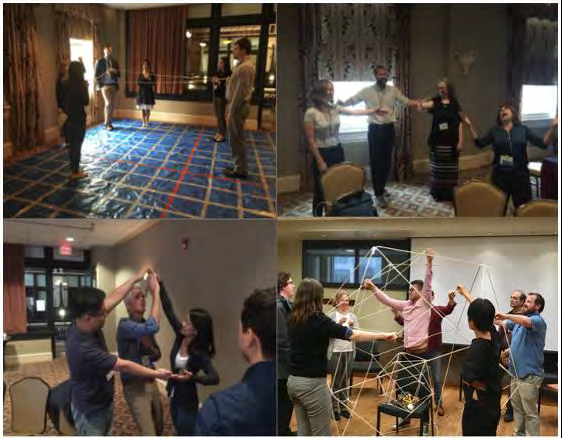

Figure 1: A small selection of embodied activities created by EMIC organizers and experienced by EMIC participants. Clockwise from top left : experiencing geometric transformations, acting out geometry conjectures, constructing icosahedra first as small, then at human scale, and enacting topological relations.
Founding Members
The EMIC community has welcomed several new members since its inception in 2015 and the leaders of our working group at PME-NA have shifted each year to reflect the focus of each annual meeting. Below are the founding members of EMIC who have led the charge for many of this group's collaborations within and between PME-NA convenings.
Candace Walkington, Southern Methodist University Caro Williams-Pierce, University at Albany, SUNY / University of Maryland David Landy, Indiana University / Netflix Dor Abrahamson, University of California, Berkeley Erin Ottmar, Worcester Polytechnic Institute Martha W. Alibali, University of Wisconsin-Madison Mitchell J. Nathan, University of Wisconsin-Madison Ricardo Nemirovsky, San Diego State University Rogers Hall, Vanderbilt University
Collective Efforts and Accomplishments
Beyond PME-NA, EMIC members have actively collaborated over the past several years to continue advancing this field of research, bridging the gap between research and classroom practice, and expanding the EMIC community. Below, we provide overviews of the progress and accomplishments shared by members of our group (see Figures 1 and 2).
Table 1: Events Organized by the EMIC Community Since PME-NA 2015
2015 EMIC Working Group at PME-NA 37 . Theme: Embodied Mathematical Imagination and Cognition. The launch of the working group and community at PME-NA. 2016 EMIC Working Group at PME-NA 38 . Theme: Finding Common Interests for Creating an Online Community of Scholars. 2017 EMIC Working Group at PME-NA 39 . Theme: Embodiment at the Crossroads of Mathematical Collaboration. Topics included the power of collaborative gestures. 2018 EMIC Working Group at PME-NA 40 . Theme: Extending Theoretical Frameworks of Embodied Cognition to Assessing and Assisting Mathematics Learning. 2019 EMIC Working Group at PME-NA 41 . Theme: Co-design of Novel Embodied Instructional Activities for Mathematics Education. Topics included the influences of eliciting movement in physical and video game-based learning activities. 2019 (May) NSF-funded EMIC I Workshop. 2020 (May). EMIC Virtual Panel #1. Hosted by embodiedmathematics.com. 2020 (October). EMIC Virtual Panel #2. Hosted by embodiedmathematics.com. 2021 (June; postponed from June 2020). EMIC Virtual Working Group at PME-NA 42 . Theme: How Embodied Mathematics Can Bridge Cultural Divides. Topics included varieties of cultural and linguistic ways of expressing mathematical ideas. 2021 (October; postponed from June 2020). NSF-funded EMIC II Workshop. 2021 (October). EMIC Research Colloquium at PME-NA 43 . Theme: Promoting Inclusive Mathematics Education Research and Practices. Topics included exploring varieties of physical inclusivity in different virtual stations and immersive technology.
Highlights: Funded Grant Proposals and Projects
Creation and maintenance of the website https://www.embodiedmathematics.com/. This is a portal for resources, events (including workshops and webinars), and announcements.
NSF EMIC I. A successful proposal to host a three-day NSF Synthesis and Design workshop, May 20-22, 2019, hosted by University of Wisconsin-Madison. The theme was "The Future of Embodied Design for Mathematical Imagination and Cognition" with 8 members serving as organizers. There were 50 attendees, comprised of international researchers, educational practitioners, and graduate students. All attendees presented. Keynotes from Dr. Brian Bottge and Dr. Maxine McKinney de Royston. This resulted in a white paper (Nathan et al., 2021) and an open access journal article (Abrahamson et al., 2020).
- Follow-up collaboration between a WG faculty member (Abrahamson) and workshop participant (Danny Luecke), a Secondary Math Education Developer/Instructor at Turtle Mountain Community College, North Dakota, to create pre-/in- service teacher courses, Ojibwe Math I, II, and III, as well as a course titled Math In Context.
NSF EMIC II. A successful proposal to host a second NSF three-day Workshop in 2020 (delayed to Sept. 25-26, 2021), hosted by Colorado State University. The theme was: "EMIC: Professional Development for Undergraduate Mathematics Instructors" with 7 member organizers. Keynotes from Dr. Nathalie Sinclair, Dr. Brooke Ernest, Dr. Francisco Ortega, & Dr. Molly Kelton.
Several grants awarded by IES CASL program to study embodied cognition, including: the role of action in pre-college proof performance in geometry (Funded 2016-2020 for Nathan & Walkington); the use of perceptual learning technology to study algebra learning (Ottmar & Landy, 2018), and use of augmented and virtual reality (AR/VR) to foster collaborative embodiment in immersive learning environments (Walkington & Nathan, 2020).
Products and Dissemination
- Invitation by Springer to produce an edited book on our collective work on Embodied Mathematical Imagination and Cognition for the Research in Mathematics Education Series (Jinfa Cai, series editor).
- Exhibit presented by Abrahamson and Rosenbaum at an NSF-funded WG meeting (EMIC I, Madison, WI) has led to a research project (Palatnik, WG faculty), a journal paper (Benally, Kimiko, Palatnik, Abrahamson, in press), and a Spencer proposal (item).
- A joint symposium on Embodied Cognition with 6 members at the 2018 APA Technology, Mind & Society Conference (Harrison et al., 2018)
- Publication of Nathan (2021), a textbook on embodied cognition for education.
Community Engagement/Broadening Participation
- Expanding a group website using the Google Sites platform to connect scholars, support ongoing interactions throughout the year, and regularly adding additional resources/activities https://sites.google.com/site/emicpmena/home
- Several members creating and teaching Embodied Cognition and Gesture seminars at their institutions.
- Extending the embodied-design agenda into special education in dialogue with Universal Design for Learning (Abrahamson, Flood, Miele, & Siu, in press)
- Some senior members joining junior members' grant proposals as Co-PIs and advisors.
- Interest from Head of Education R&D (Dr. Ilona łowiecka-Tańska) of the largest STEM museum in Europe (the Copernicus Hall of Science in Warsaw, Poland) to incorporate
exhibits that had been developed for/at an NSF-funded WG meeting (EMIC I, Madison, WI) by Abrahamson and Rosenbaum.
- EMIC Virtual Workshop #1, May 19, 2020. Theme: "Instructional Gestures for Classrooms and On-Line Mathematics Learning." Designed for an audience of K-16 teachers, parents, and mathematics education researchers. Panelists: Dr. Mitchell J. Nathan, Dr. Martha Alibali, & Dr. Rebecca Boncoddo. Discussant: Dr. Hortensia Soto. Moderator: Dr. Caro Williams-Pierce. Hosted by embodiedmathematics.com.
- EMIC Virtual Workshop #1, October 12, 2020. Theme: "Reading Group: The Future of Embodied Design for Mathematics Teaching and Learning." Convener: Dr. Dor Abrahamson, with a panel of authors from the (Abrahamson et al., 2020) paper.
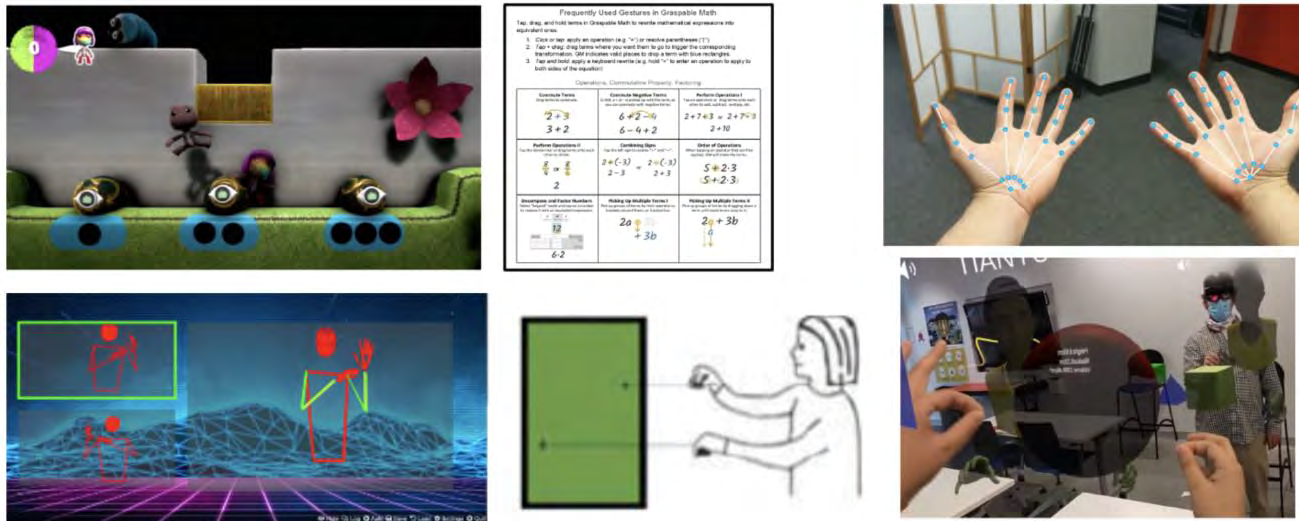
Figure 2: Embodied technologies designed by EMIC members that engage body based processes in support of mathematical reasoning. Clockwise from top left: The collaborative video game, Rolly's Adventure; Graspable Math; hand joints and holographic math objects in the augmented reality/virtual reality (AR/VR) shAR Geometry environment; Mathematical Imagery Trainer for Proportion (MIT-P); The Hidden Village-Online.
Conclusions and Looking Ahead
Embodied accounts of reasoning, learning, and instruction are proving to be highly generative frameworks for understanding and cultivating mathematics learning and teaching, and for informing a new generation of designs for interactive technologies, curricula, and assessments. The true potential for these ideas and practices to lead to transformational mathematics education depends on a thriving, informed, interactive community of scholars and practitioners who engage with these approaches, evaluate their impacts, and improve theory and practice. Thus, we see predictably recurrent events such as the PME-NA working groups and research colloquia as a cornerstone for maintaining a highly educated and engaged core community. We will continue to offer outreach events and pursue external funding for specialized workshops when the resources are available. Future research colloquium topics that offer particular promise to the mathematics education community are: Broadening participation in mathematics and STEM through embodied design for learning, teaching, and assessment; the growing access to augmented and immersive technology, such as AR and VR, as a means to transform learners' collaborative interactions with mathematical objects and phenomena
(Walkington et al., 2021); and the potential for multimodal learning analytics that use machine learning methods to integrate complex data streams that include channels of speech, gesture, eye gaze, facial expressions, mouse clicks, and so on, to support more sophisticated descriptions of learners' behaviors that can lead to real-time formative assessment and predictive models of educationally important student outcomes (Abrahamson et al., 2021; Closser, 2021).
Acknowledgments
We wish to acknowledge the scholars and educators who have been the backbone of these interactive working groups, workshops, and panels by providing the stimulating intellectual environment for these ideas to take root and blossom. We also wish to acknowledge the generous funding from NSF-DCL Grant #1824662 and NSF-DUE Grant #1835409.
EMBODIED MATHEMATICAL IMAGINATION AND COGNITION (EMIC) RESEARCH COLLOQUIUM COLOQUIO DE INVESTIGACIÓN: COGNICIÓN E IMAGINACIÓN MATEMATICA INCORPORADA COLLOQUE DE RECHERCHE: IMAGINATION ET COGNITION MATHÉMATIQUES
Mitchell J. Nathan
- U. of Wisconsin - Madison mnathan@wisc.edu
Erin Ottmar Worcester Polytechnic Inst. erottmar@wpi.edu
INTÉGRÉES
Candace Walkington Avery Harrison Closser Southern Methodist University Worcester Polytechnic Inst. cwalkington@mail.smu.edu ahclosser@wpi.edu Martha Wagner Alibali Hannah Smith
- U. of Wisconsin - Madison Worcester Polytechnic Inst. Martha.alibali@wisc.edu hsmith2@wpi.edu
The Embodied Mathematical Imagination and Cognition (EMIC) Research Colloquium offers hands-on individual and collaborative mathematics activities; technological, curricular, and pedagogical demonstrations; and open spaces for exploration and discussion regarding the embodied nature of mathematics education. At PME-NA 44 we will use the conference theme of "critical dissonance and resonant harmony" to invite the community to directly experience some of the many ways embodied perspectives challenge the status quo through expanded notions of mathematical activity and assessment, and to explore some current contributions, future potential, and challenges for more inclusive educational experiences for learners and teachers.
Keywords: Cognition; Learning Theory; Social Justice; Systemic Change; Technology
Theoretical Background
It is increasingly apparent that effective mathematics education systems need to address the embodied needs of learners by designing educational experiences that: 1) are grounded in people's natural propensities for movement, sensation, perception, and collaborative interactions with cultural and scientific tools; 2) support "multiple linguistic repertoires," (McKinney de Royston et al., 2020, p. 10) including verbal, nonverbal, and multimodal ways of knowing, communicating, and assessment; and 3) facilitate learners' participation in systems that support the distributed nature of knowledge and reasoning (e.g., Abrahamson 2014; Alibali & Nathan, 2012; Arzarello et al., 2009; De Freitas & Sinclair, 2014; Edwards et al., 2014; Radford 2009; Walkington et al., 2021). Evidence-based design principles are informing innovations in material-based curricula and digital technologies that support embodied mathematical imagination and cognition (EMIC) using platforms such as physical and video games, skits and virtual reality, craft making and tactile computing, motion capture, and participatory simulations (e.g., Abrahamson et al., 2020).
A Brief History and Motivation of the EMIC Working Group
The EMIC working group officially started in East Lansing, MI during PME-NA 2015. However, it emerged from a variety of earlier initiatives, including a 2007 AERA symposium, "Mathematics Learning and Embodied Cognition," a 6-year NSF-REESE grant (Nemirovsky et al., 2008), special issues of Educational Studies in Mathematics (2009), The Journal of the Learning Sciences (2012), and an NCTM 2013 research pre-session keynote panel, "Embodied cognition: What it means to know and do mathematics." A group of PME-NA members
recognized a "critical mass" of investigators involved in related projects, and contributed findings and conceptual frameworks to form a stable and growing mathematics education research community to discuss, explore, and advance this scholarly program. We have convened annually at PME-NA ever since, organizing events that investigate the embodied nature of mathematics through physical and digital games, art and craft, individual and collaborative dance and movement, language, perception, immersive experiences, and more. EMIC members have continued to explore new technologies (e.g., Harrison et al., 2018; Walkington et al., 2021) and research methods (e.g., Abrahamson et al., 2021; Closser et al., 2021). They go beyond scholarly publications and presentations to offer:
- novel embodied technologies, including some that have gone to scale, for classroom use, special education, and emerging bilinguals;
- teacher learning programs for instructional uses of gestures;
- and webinars for teachers and parents. We are redesigning our website so it can continue to serve as a portal for resources, events (including workshops and webinars), teaching materials (e.g., syllabi), and announcements.
EMIC 2022: Critical Dissonance and Resonant Harmony
The organizers (including the authors; plus Dr. Janet Walkoe, U. MD and coordinator M. Nathan) have several years of experience co-designing and facilitating the PME-NA sessions. In 2022, we will organize hands-on activities and group discussions around the central questions that frame this year's conference theme. On Day 1 , we will use these prompts in small-group interactions to guide design activities with participants around (a) developmentally appropriate math topics (e.g., number, operations & algebra; geometry & measurement; probability & data analysis; functions & calculus; etc.); (b) research questions and designs for exploring embodiment of that topic; and (c) considerations of embodiment (vs. traditional) approaches to lesson design, instruction, and assessment. The first day will explore "How does this approach challenge a settled mathematics learning status quo?" As one example, an EMIC perspective might reframe high school geometry proofs from static two-column schemas to a deductive process grounded in movement- and object-based transformations. At least one organizer will join each small group. Day 1 will also include open-ended Q&A on the nature of embodiment theory, research methods, and design principles. On Day 2 , participant-groups (membership can be fluid) will explore "How does this approach help to create more socially just contexts for learning and teaching mathematics?" and "Whose voice does your work center in the mathematics learning process?" We will start this off by sharing findings and videos from the EMIC community demonstrating examples of support for emerging bilingual students and students with physical disabilities. An example is describing expansive forms of assessment practices that include ways students exhibit nonverbal (e.g., gesture-based) and distributed ways of knowing.
Day 3 reconfigures the small groups around common themes that arose in topic-specific groups on Days 1 & 2. We will invite these groups to reflect on who math education experiences are designed for, who is systematically marginalized, and what is gained in a truly inclusive approach. We then shift to a facilitated whole-group discussion, inviting members of each group to share ways an embodied framework can improve learning conditions for every mathematics learner, and benefit society more broadly.
Conclusions and Looking Ahead
Embodied approaches to design, instruction, and assessment show promise for fostering systemic change and harmony in mathematics education for amplifying inclusion of historically marginalized communities. There is much more to do to understand these impacts and realize their potential. An engaged community is vital for such transformative work to occur.
Keywords
Citations
| Domain | Field | Subfield | Topic | Full text | Expand | |||||
|---|---|---|---|---|---|---|---|---|---|---|
Abstract Source: Domain: Subfield: Concepts Cited by: Full reference page → | ||||||||||
9 citation keys could not be linked to the reference collection: arzarello2009, benally, lakoff2000, radford2009, lischka2022, arzarello2009a, mckinneyderoyston2020, radford2009a, lischka2022a