Embodied Mathematical Imagination and Cognition (EMIC) Working Group
Erin R Ottmar; Edward Melcer; Dor Abrahamson; Mitchell J Nathan; Emily Fyfe; Carmen Smith
2018 · PMENA 40
Abstract
Embodied cognition is growing in theoretical importance and as a driving set of design principles for curriculum activities and technology innovations for mathematics education. The central aim of the EMIC (Embodied Mathematical Imagination and Cognition) Working Group is to attract engaged and inspired colleagues into a growing community of discourse around theoretical, technological, and methodological developments for advancing the study of embodied cognition for mathematics education. A thriving, informed, and interconnected community of scholars organized around embodied mathematical cognition will broaden the range of activities, practices, and emerging technologies that count as mathematical. EMIC builds upon our prior working groups with a specific focus on how we can leverage emerging technologies to study embodied cognition and mathematics learning. In particular, we aim to develop new theories and extend existing frameworks and perspectives from which EMIC collaboration and activities can emerge.
Full text
Motivations for This Working Group
Recent empirical, theoretical and methodological developments in embodied cognition and gesture studies provide a solid and generative foundation for the establishment of
a regularly held Embodied Mathematical Imagination and Cognition (EMIC) Working Group
for PME-NA. The central aim of EMIC is to attract engaged and inspired colleagues into a growing community of discourse around theoretical, technological, and methodological developments for advancing the study of embodied cognition for mathematics education, including, but not limited to, studies of mathematical reasoning, instruction, the design and use of technological innovations, learning in and outside of formal educational settings, and across the lifespan. The interplay of multiple perspectives and intellectual trajectories is vital for the study of embodied mathematical cognition to flourish. While there is significant convergence of theoretical, technological, and methodological developments in embodied cognition, there is also a trove of technological, methodological, and theoretical questions that must be addressed before we can formulate and implement effective design principles. As a group, we aim to address basic theoretical questions such as, What is grounding? And practical ones such as, How can we reliably engineer the grounding of specific mathematical ideas? We need to understand how variations in actions and perceptions influence mathematical reasoning, including self-initiated vs. prescribed actions, and actions that take place in intrapersonal versus interpersonal interactions; how gestural point-of-view when enacting phenomena from a first- versus thirdperson perspective, including how gestures move through space, influences reasoning and communication; how actions enacted by oneself, observed in others, or imagined influence
cognition; and how gestures connect with external visual representations (Alibali & Nathan, 2012; in press). A thriving, informed, and interconnected community of scholars organized around embodied mathematical cognition will broaden the range of activities and emerging technologies that count as mathematical, and envision alternative forms of engagement with mathematical ideas and practices (e.g., De Freitas & Sinclair, 2014). This broadening is particularly important at a time when schools and communities in North America face persistent achievement gaps between groups of students from many ethnic backgrounds, geographic regions, and socioeconomic circumstances (Ladson-Billings, 1995; Moses & Cobb, 2001; Rosebery, Warren, Ballenger & Ogonowski, 2005). There also is a need to articulate evidence-based findings and principles of embodied cognition to the research and development communities that are looking to generate and disseminate innovative programs for promoting mathematics learning through movement (e.g., Ottmar & Landy, 2016; Smith, King, & Hoyte, 2014). Generating, evaluating, and curating empirically validated and reliable methods for promoting mathematical development and effective instruction through embodied activities that are engaging and curricularly relevant is an urgent societal goal. As embodied cognition gains prominence in education, so, too, does new ways of using technology to support teaching and learning (Lee, 2015). These new uses of technology, in turn, offer novel opportunities for students and scientists to engage in math visualization, symbolization, intuition, and reasoning. In order for these designs to successfully scale up, they must be informed by research that demonstrates both ecological and internal validity.
Past Meetings and Achievements of the EMIC Working Group
"Mathematics Learning and Embodied Cognition," the first PME-NA meeting of the EMIC working group, took place in East Lansing, MI in 2015. Our group has been growing ever since. In addition to the PME-NA meeting each year, there are a number of ongoing activities that our members engage in. We have built an active website which provides updates on projects, and hosts resources. On this website, we have a list of members with their emails and bios, information about our PME-NA presence, and short personal introduction videos. We've also created a space for members to share information about their research activities – particularly for videos of the complex gesture and action-based interactions that are difficult to express in text format. In addition, we have a common publications repository to share files or links (including to ResearchGate or Academia.edu publication profiles, so members don't have to upload their files in multiple places). Our members collaborate on ongoing projects, and have presented at other pre-conference workshop events such as the Computer Supported Collaborative Learning conference (Williams-Pierce et al., 2017), and the APA Technology, Mind, and Society conference (Harrison et. al, 2018). Several research programs have formed to investigate the embodied nature of mathematics (e.g., Abrahamson 2014; Alibali & Nathan, 2012; Arzarello et al., 2009; De Freitas & Sinclair, 2014; Edwards, Ferrara, & Moore-Russo, 2014; Lakoff & Núñez, 2000; Melcer & Isbister, 2016; Ottmar & Landy, 2016; Radford 2009; Nathan, Walkington, Boncoddo, Pier, Williams, & Alibali, 2014; Soto-Johnson & Troup, 2014; Soto- Johnson, Hancock, & Oehrtman, 2016), demonstrating a "critical mass" of projects, findings, senior and junior investigators, and conceptual frameworks to support an ongoing community of like minded scholars within the mathematics education research community. Some of our collaborative accomplishments since 2015 include:
- Developing a group website using the Google Sites platform to connect scholars, support ongoing interactions throughout the year, and regularly adding additional resources/activities https://sites.google.com/site/emicpmena/home
- Joint submission of several NSF grants by members who first met during the 2015 EMIC sessions
- Some senior members joining junior members' NSF grant proposals as Co-PIs and advisors
- Submission to the IES CASL program to study the role of action in pre-college proof performance in geometry (Funded 2016-2020 for Nathan & Walkington), as well of the use of perceptual learning on algebra learning (Ottmar & Landy, 2018)
- Submission of 2 NSF Proposals to host Workshops on Embodied Cognition (one for researchers and one for K-16 math educators)
- A joint symposium on Embodied Cognition with 6 members at the 2018 APA Technology, Mind & Society Conference
- Examining the potential for an NSF Research Coordination Network (RCN)
- Application for a grant from Association for Psychological Science (APS) to develop a better website and offer stipends for contributors
- Presenting a pre-conference workshop to CSCL 2017 on the embodied tools to promote STEM education (Williams-Pierce et al., 2017)
- A Conference at Berkeley's Graduate School of Education to examine the relevance of coordination dynamics -- the non-linear perspective on kinesiological development -- to individuals' sensorimotor construction of perceptual structures underlying mathematical concepts. https://edrl.berkeley.edu/cdme2018
Current Working Group Organizers
As the Working Group has matured and expanded, we have a broadening set of organizers that represent a range of institutions and theoretical perspectives (and is beyond the limit of six authors in the submission system). This, we believe, enriches the Working Group experience and the long-term viability of the scholarly community. The current organizers for 2018 are (alphabetical by first name):
- Candace Walkington, Southern Methodist University
- Carmen J. Petrick Smith, University of Vermont
- Caro Williams-Pierce, University at Albany, SUNY
- David Landy, Indiana University
- Dor Abrahamson, University of California, Berkeley
- Edward Melcer, University of California, Santa Cruz
- Emily Fyfe, Indiana University
- Erin Ottmar, Worcester Polytechnic Institute
- Hortensia Soto–Johnson, University of Northern Colorado
- Ivon Arroyo, Worcester Polytechnic Institute
- Martha W. Alibali, University of Wisconsin-Madison
- Mitchell J. Nathan, University of Wisconsin-Madison
Focal Issues in the Psychology of Mathematics Education
education, and the learning sciences that frame human communication as multimodal interaction, and human thinking as multi-modal simulation of sensory-motor activity (Clark, 2008; Hostetter & Alibali, 2008; Lave, 1988; Nathan, 2014; Varela et al., 1992; Wilson, 2002). As Stevens (2012, p. 346) argues in his introduction to the JLS special issue on embodiment of mathematical reasoning, "it will be hard to consign the body to the sidelines of mathematical cognition ever again if our goal is to make sense of how people make sense and take action with mathematical ideas, tools, and forms". Four major ideas exemplify the plurality of ways that embodied cognition perspectives are relevant for the study of mathematical understanding: (1) Grounding of abstraction in perceptuo-motor activity as one alternative to representing concepts as purely amodal, abstract, arbitrary, and self-referential symbol systems. This conception shifts the locus of "thinking" from a central processor to a distributed web of perceptuo-motor activity situated within a physical and social setting. (2) Cognition emerges from perceptually guided action (Varela, Thompson, & Rosch, 1991). This tenet implies that things, including mathematical symbols and representations, are understood by the actions and practices we can perform with them, and by mentally simulating and imagining the actions and practices that underlie or constitute them. (3) Mathematics learning is always affective : There are no purely procedural or "neutral" forms of reasoning detached from the circulation of bodily-based feelings and interpretations surrounding our encounters with them. (4) Mathematical ideas are conveyed using rich, multimodal forms of communication, including gestures and tangible objects in the world. In addition to theoretical and empirical advances, new technical advances in multi-modal and spatial analysis have allowed scholars to collect new sources of evidence and subject them to powerful analytic procedures, from which they may propose new theories of embodied mathematical cognition and learning. Growth of interest in multi-modal aspects of communication have been enabled by high quality video recording of human activity (e.g., Alibali et al., 2014; Levine & Scollon, 2004), motion capture technology (Hall, Ma, & Nemirovsky, 2014; Sinclair, 2014), developments in brain imaging (e.g., Barsalou, 2008; Gallese & Lakoff, 2005), multimodal learning analytics (Worsley & Blikstein, 2014), and data logs generated from embodied math learning technologies that interacts with touch and mouse-based interfaces (Manzo, Ottmar, & Landy, 2016).
Theme: Looking Back, Looking Ahead: Celebrating 40 Years of PME-NA
Inspired by the PME-NA 2018 theme, we will specifically focus on the ways in which the field of embodied cognition has developed and how new emerging technologies and innovative pedagogies can influence mathematics teaching and learning. This effort will be crafted to align with recent developments in the embodiment literature, and new theoretical frameworks tying various perspectives on embodiment to different forms of physicality in educational technology (Melcer & Isbister, 2016; see Figure 1 below).
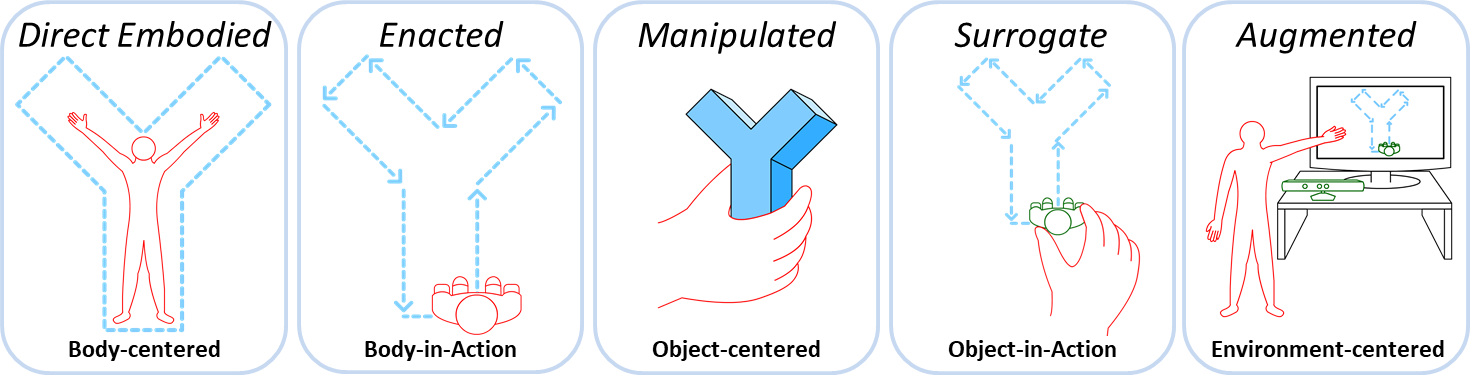

Figure 1. Five distinct approaches to facilitating embodiment through bodily action, objects, and the surrounding environment in educational technology.
Examples include: coding videos of pre-service teachers' distributed gestures to explore a mathematical conjecture (Walkington et al., 2018); exploring mathematical transformations while using a dynamic technology tool (Ottmar & Landy, 2016), having students and teachers play and create embodied technology games to teach mathematics and computational thinking (Arroyo et al., 2017; Melcer & Isbister, 2018); usng dual eye tracking (Shvarts & Abrahamson, 2018), and a teacher guiding the movements of a learner exploring ratios (Abrahamson & Sánchez-García, 2016). Through these examples, we will explore questions such as: what role does technology play on supporting the connections between the mind, body, and action? During the conference, participants in our EMIC workshop will engage in dedicated activities and guided reflections as a basis for exploring the role of technology, action, and embodiment in the emergence of mathematics learning.
Plan for Active Engagement of Participants
Our formula from prior PME-NA working groups proved to be effective: By inviting participants into open ended math activities at the beginning of each session, we were rapidly drawn into those very aspects of mathematics that we find most rewarding. We plan to facilitate collaborative EMIC activities, followed by group discussions (and we now have many activities and members who can trade off in these roles!) that will help us all to "pull back" to the theoretical and methodological issues that are central to advancing math education research. Within this structure of beginning with mathematical activities and facilitated discussions, on Day 1 we plan to begin with four different group activities that highlight the interplay of mathematics content, cognition, physicality, and action. These activities will serve as the foundation for a broad group discussion about the varied roles of technology in EMIC. See Figure 2 below for examples of collaborative activities from PME-NA 2017.
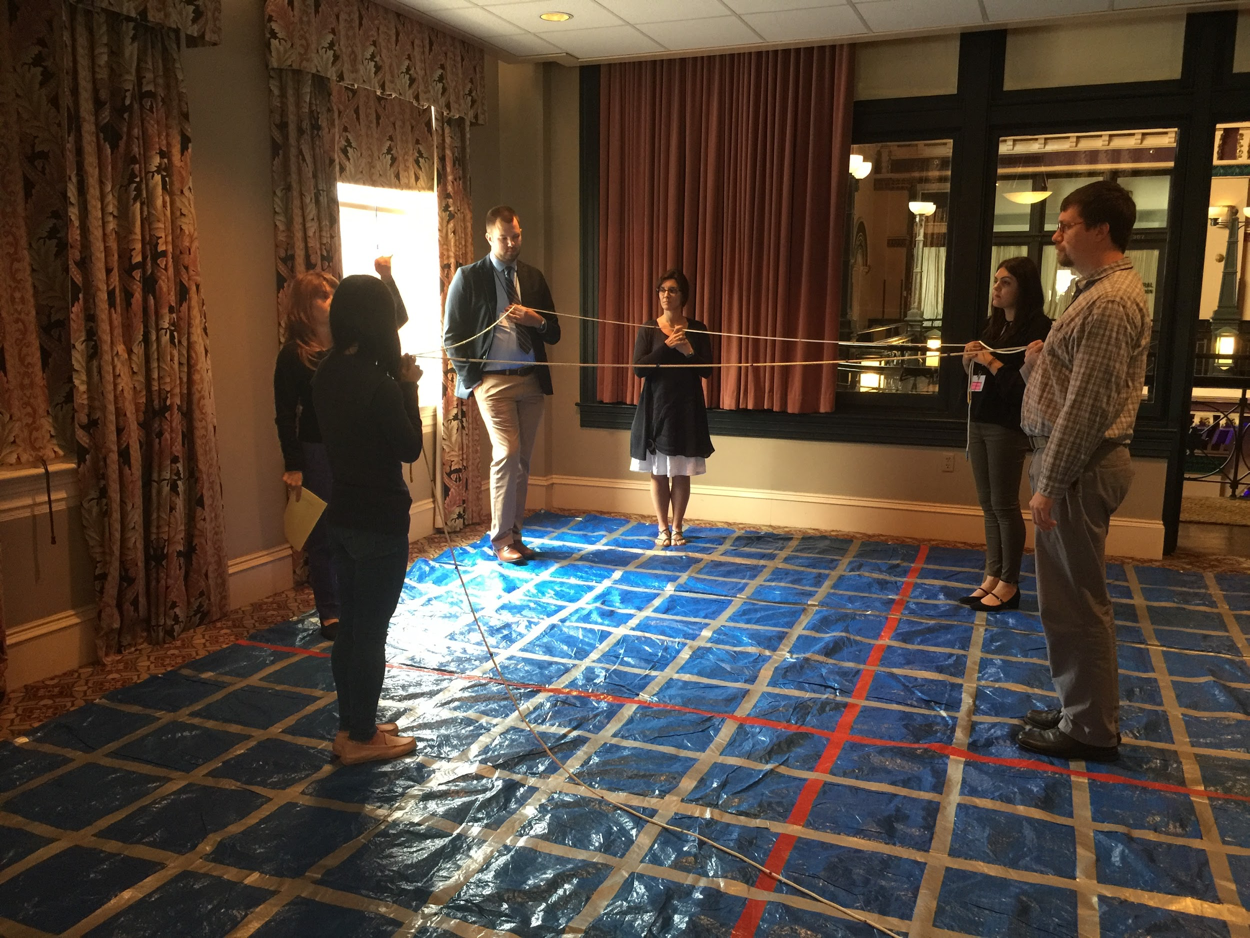
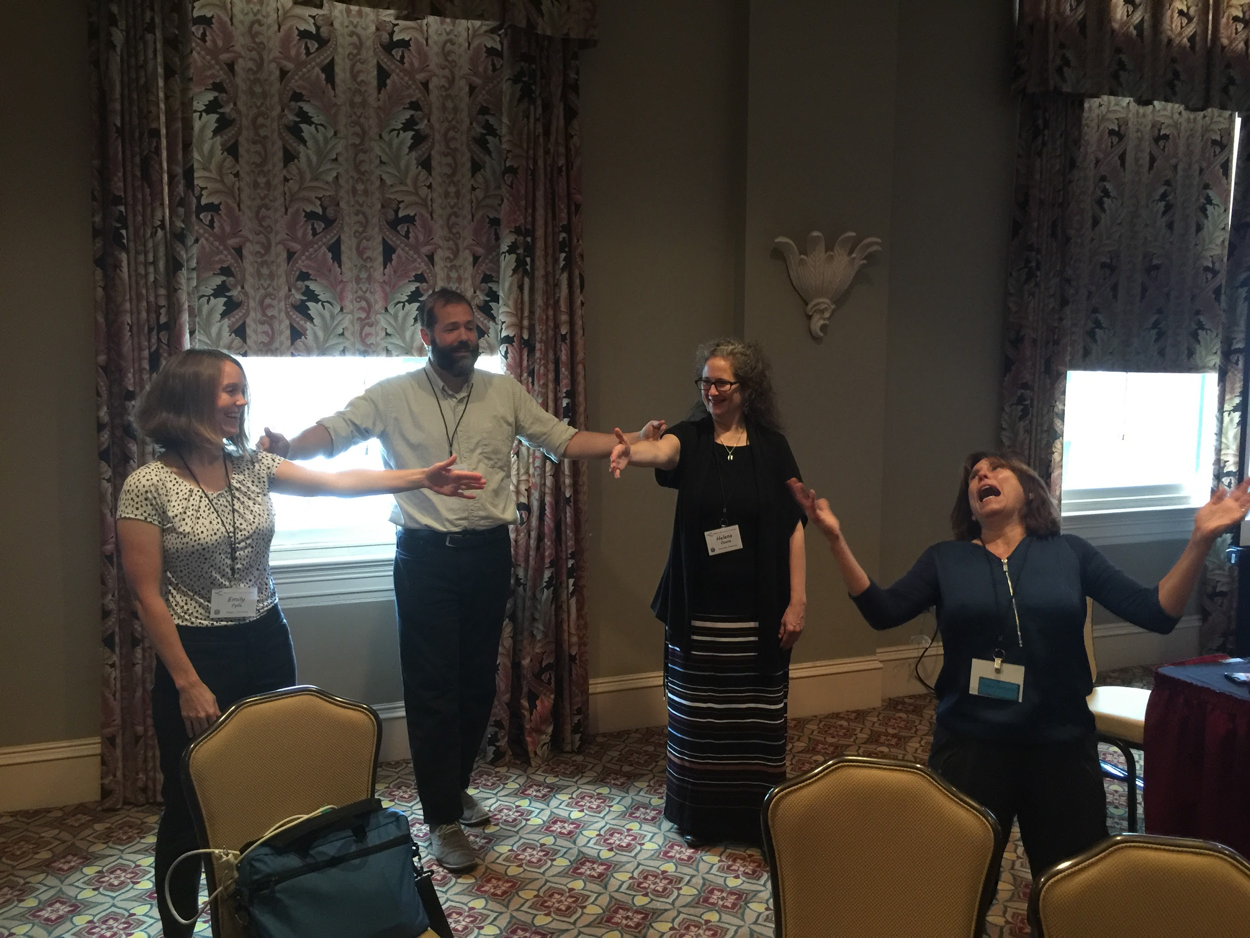
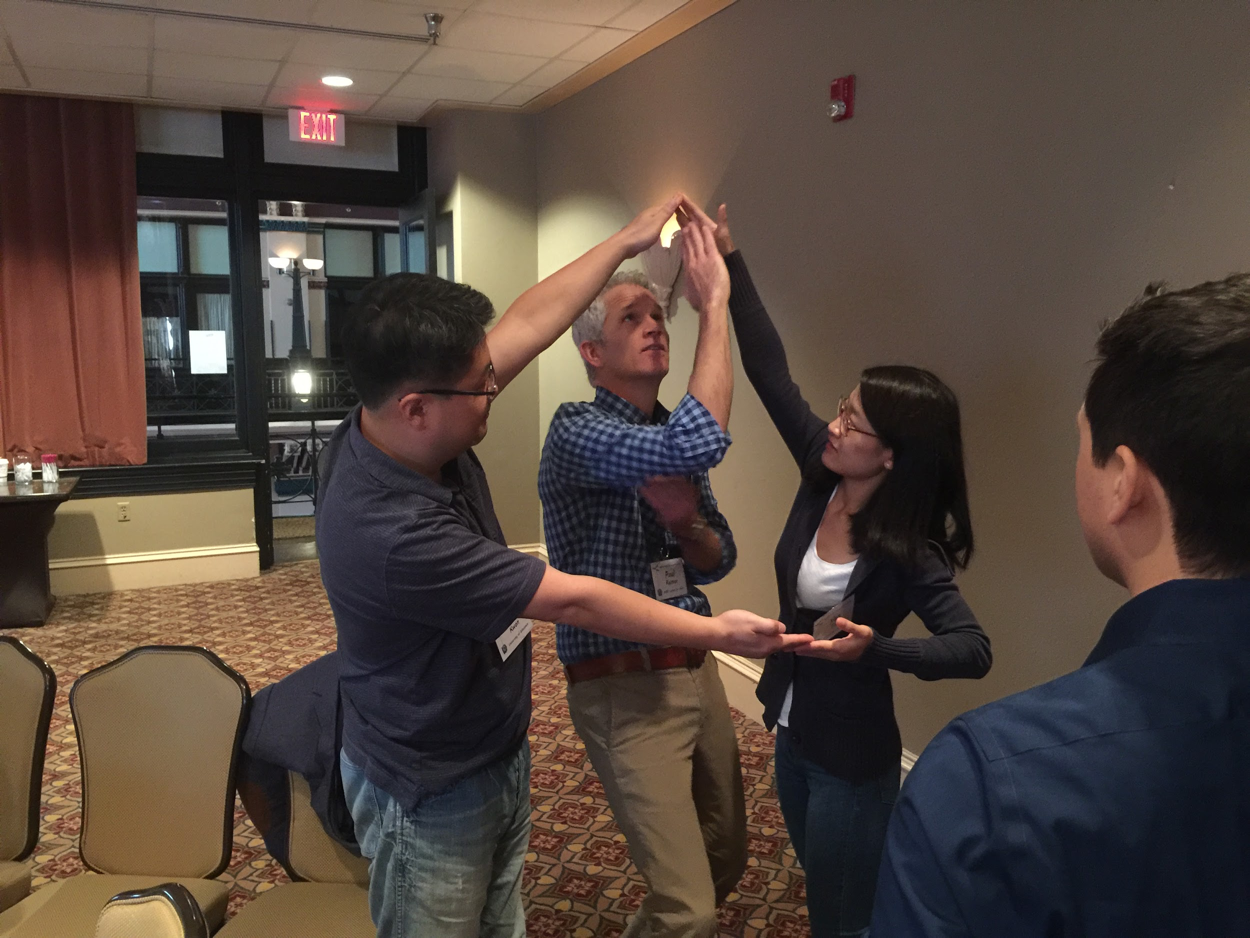
Figure 2. Collaborative activities. Participants explore geometric rotation and reflection(left); two groups act out and prove mathematical conjectures (middle and right).
The full first session will generally be taken up by introductions and a round of open-ended activities followed by discussion. On Day 2 , we will begin the session with technology-based collaborative activities, with four stations that pairs of participants rotate through. Examples of three of those stations are in Figure 3. Continuing with the routine established in Day 1, a full group discussion will follow, with a particular focus on designing EMIC digital contexts to support ongoing collaboration.
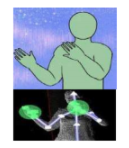

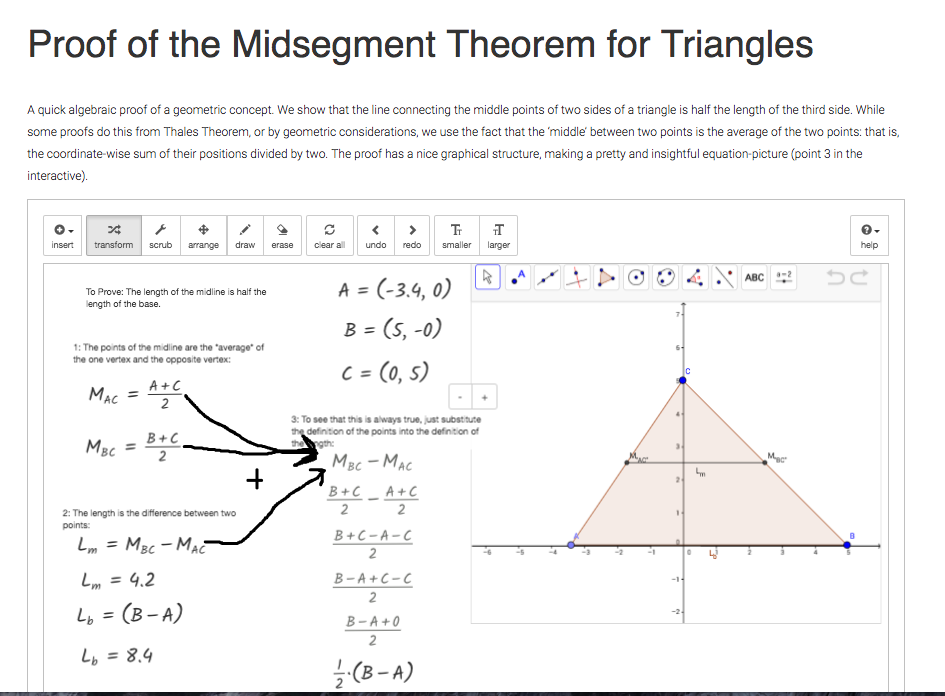

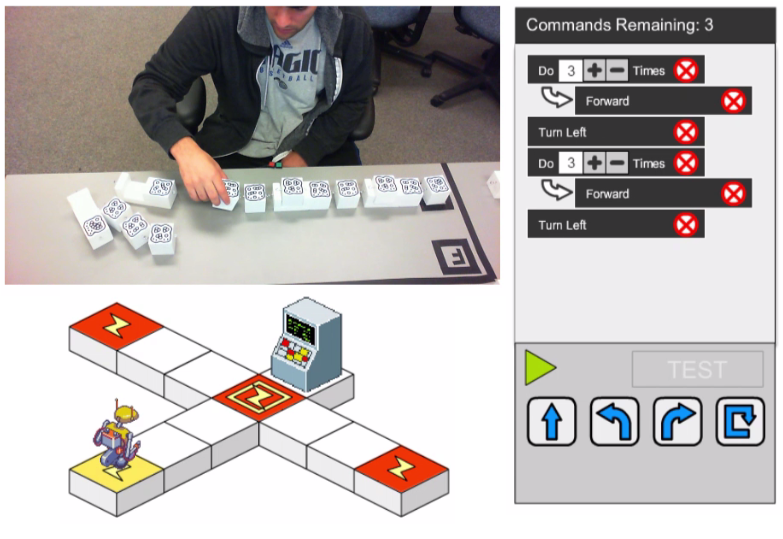

Figure 3. Technology activities. The Hidden Village (left); Graspable Math (middle); Bots &
(Main)Frames (right).
After the discussion, we will discuss different EMIC activity ideas, with the goal of developing additional collaborative activities that can be used in various research and learning contexts. The final activities will be shared on the EMIC website.
Day 3 is agenda-setting day, where we all discuss how we will keep the momentum going, such as developing an NSF Research Coordination Network (RCN) to build the networked community of international scholars from which many fruitful lines of inquiry can emerge. A second group may draft a proposal for a special issue of the Journal of Research in Mathematics Education that focuses on creating an integrated theoretical framework or sharing the different theoretical perspectives, research activities, and operationalization of EMIC by the working group members. In order to find common ground for the RCN submission and the JRME special issue, we will perform a live concept mapping activity that is displayed for all participants to explore the range of EMIC topics and identify common conceptual structure. We will discuss different general foci, such as teacher professional development with EMIC, designing EMIC games or museum exhibits, etc. Building on the four major ideas that we developed earlier, possible topics for organizing this activity will be explored, such as:
Grounding Abstractions
- Conceptual blending (Tunner & Fauconnier, 1995) & metaphor (Lakoff & Núñez, 2000)
- Perceptuo-motor grounding of abstractions (Barsalou, 2008; Glenberg, 1997; Ottmar & Landy, 2016; Landy, Allen, & Zednik, 2014)
- Progressive formalization (Nathan, 2012; Romberg, 2001) & concreteness fading (Fyfe, McNeil, Son, & Goldstone, 2014)
- Use of manipulatives (Martin & Schwartz, 2005)
Cognition emerges from perceptually guided action: Designing interactive learning environments for EMIC
- Development of spatial reasoning (Uttal et al., 2009)
- Math cognition through action (Abrahamson, 2014; Nathan et al., 2014)
- Perceptual boundedness (Bieda & Nathan, 2009)
- Perceptuomotor integration (Ottmar, Landy, Goldstone, & Weitnauer, 2015; Nemirovsky, Kelton, & Rhodehamel, 2013)
- Attentional anchors and the emergence of mathematical objects (Abrahamson & Bakker, 2016; Abrahamson & Sánchez–García, 2016; Abrahamson et al., 2016; Duijzer et al., 2017)
- Mathematical imagination (Nemirovsky, Kelton, & Rhodehamel, 2012)
- Students' integer arithmetic learning depends on their actions (Nurnberger-Haag, 2015).
Affective Mathematics
- Modal engagements (Hall & Nemirovsky, 2012; Nathan et al., 2013)
- Sensuous cognition (Radford, 2009)
Gesture and Multimodality
- Gesture & multimodal instruction (Alibali & Nathan 2012; Cook et al., 2008; Edwards, 2009)
- Bodily activity of professional mathematicians (Nemirovsky & Smith, 2013; Soto-Johnson, Hancock, & Oehrtman, 2016)
- Simulation of sensory-motor activity (Hostetter & Alibali, 2008; Nemirovsky & Ferrara, 2009)
We will also discuss the implications of this work and the different areas of the concept map for teaching, and discuss ideas for bridging the gap between research and practice.
Follow-up Activities
We envision an emergent process for the specific follow-up activities based on participant input and our multi-day discussions. At a minimum, we will continue to develop a list of interested participants and grant them all access to our common discussion forum and literature compilation. Those that are interested in the NSF RCN plan will work to form the international set of collaborations and articulate the intellectual topics that will knit the network together; and those that are interested in the JRME special issue proposal will outline a specific timeline for progressing. One additional set of activities we hope to explore is to create a series of instructional activities that can be used to introduce educational practitioners at all levels of administration and across the lifespan to the power and utility of the EMIC perspective. In the past several years, we have seen a great deal of progress. This is perhaps best exemplified by coming together of the EMIC website, the ongoing collaborations between members, and the annual workshops, which each draws across multiple institutions. We thus will strive to explore ways to reach farther outside of our young group to continually make our work relevant, while also seeking to bolster and refine the theoretical underpinnings of an embodied view of mathematical thinking and teaching.
Keywords
Citations
| Domain | Field | Subfield | Topic | Full text | Expand | |||||
|---|---|---|---|---|---|---|---|---|---|---|
Abstract Source: Domain: Subfield: Concepts Cited by: Full reference page → | ||||||||||
22 citation keys could not be linked to the reference collection: hodges2018, arzarello2009, barsalou2008, cook2008, edwards2009, edwards2009a, goldstone2005, hall2012, lakoff2000, hodges2018a, 2004, nemirovsky2007, nemirovsky2009, nez2004, bartell, radford2009, hodges2018b, stevens2012, uttal2009, varela1991, williamspierce, stamper